
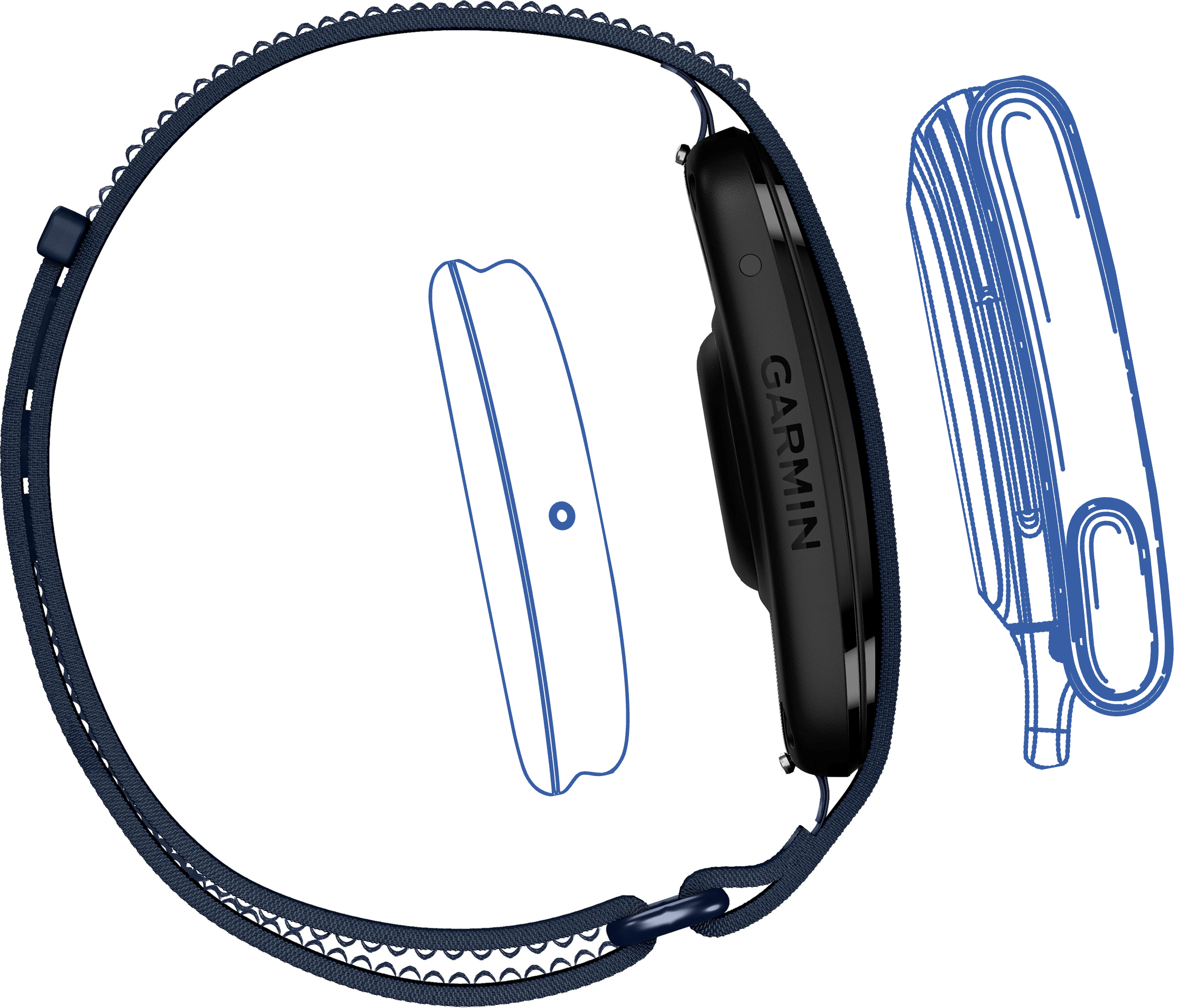
Garmin will make live heart rate data free for CIRQA owners, reversing a launch decision that had drawn immediate criticism from its customer base. Sports tech blogger Ray Maker reported the change, one of several features that previously required a Garmin Connect+ subscription.
The £179.99 band went on sale on earlier this year. Garmin positioned it as a direct challenger to screenless fitness bands like the Whoop 5.0 / MG and Fitbit Air, differentiating on features available without a subscription. Activity tracking, sleep tracking, Body Battery and Training Readiness scores were all free. Calorie tracking, personalised nutrition, Garmin Coach plans and live activity metrics, such as live heart rate sat behind the Connect+ paywall.
Architecture trade-offs
Garmin makes live heart rate viewable for free across its other smartwatches and trackers, which makes the Cirqa’s restriction look potentially less like a policy position and more like an artefact of where the device design stemmed from. Architecturally, the Cirqa appears to follow the same design ethos as the company’s Sleep Index Monitor, launched in mid summer 2025.
The Sleep Index Monitor runs a nRF52 series chipset from Nordic Semi for its Bluetooth backhaul and the Ambiq Apollo3 family for sensor processing, a combination chosen for low-power operation rather than display driving. The choice for two ARM Cortex M4Fs is likely due to codebase sharing with earlier Apollo 2 series running Garmin’s Forerunner line of products, and the want for ANT+ connectivity, which the Ambiq family lacks. Shrinking the Sleep Index Monitor’s PCB into a wrist form factor is a more favourable engineering route than stripping the screen and its associated circuitry.
While it is likely the CIRQA is running the same architecture as the sleep product, running ANT+ alongside Bluetooth means power spent on the radio transmitting. It’s reasonable to think Garmin’s priority was maximising battery life for the majority of users, and with the smaller form factor’s reduced battery capacity, this could have lead to omitting the live heart rate feature.
The market has changed underneath them
Whatever drove the decision, Garmin launched into a very different market from the one WHOOP had largely to itself. The Amazfit Helio Strap and Fitbit Air both offer real-time heart rate without a subscription, and both sit at the sub £100 price point, with the Fitbit Air sitting under half the CIRQA’s £179.99. Fitbit Air pairs with Google Health Premium at £7.99 a month (or £79.99 a year), though the hardware works without it. WHOOP takes the opposite approach entirely, with hardware only available through a hefty subscription starting at £169 every year.
Twelve months ago this was a category with one dominant player. Now there are devices at multiple price points, several undercutting WHOOP substantially, all measuring broadly the same things using broadly the same sensor stack: PPG for heart rate and HRV, an accelerometer for motion tracking, occasionally a skin temperature sensor. The only real differentiation has been happening in firmware and app subscriptions rather than in hardware.
Sensing beyond PPG
When several devices measure the same metrics from broadly similar sensor sets, the competition collapses onto price and software. The screenless form factor, unlike the smart ring, has the distinct advantage to add sensing modalities without the constraints other wearables face, since the absence of a screen opens the possibility of tighter mechanical integration. With these dedicated fitness trackers sitting against skin continuously, and without the bloat of a wearable user interface, a host of capabilities becomes viable, from hydration measurement and sweat chemistry to environmental sensing to name a few. Many of these already exist within research groups or in specialist medical devices. The difficulty tends to lie in their integration, such as keeping a new sensing modality accurate through motion artefact and everyday wear.
Where this gets built
Getting a new sensing modality onto a body reliably, and then through to manufacturing at volume, is the harder half of the problem. Making it work once on a bench is where most of these ideas can grind to a halt. That gap is where we spend most of our time. If you are looking at this market and the answer you are reaching for is experimenting with integrating a new sensing modality, then that’s a conversation worth having.