An open e-textile patent landscape dataset of 45,582 patent families
We have released our e-textile patent search query and a dataset of 45,582 patent families, free to inspect, rerun and adapt.
We have openly released an e-textile patent landscape dataset of 45,582 patent families, together with the search query that built it. Anyone can inspect it, rerun it or adapt it for their own field, without needing a commercial patent database subscription. The work was co-developed with Chartered and European Patent Attorney Samuel Bird of Hanna & Bird IP, and accompanies a conference paper presented at E-Textiles 2026.
Why e-textile patents are hard to search
A substantial volume of applied e-textile advancement is disclosed through patent filings that seldom intersect with academic review. In mature fields such as pharmaceuticals, semiconductors and telecommunications, patent landscape analysis is a routine input to research strategy, yet it is notably absent from academic e-textile work.
Three practical barriers stand in the way. Patent language is drafted for legal breadth, so a paper on a knitted strain sensor and a patent on “interlooped conductive fibers” can describe similar inventions with almost no shared vocabulary. Relevant filings are scattered across many patent classes spanning textiles, electronics, sensors and garments. And commercial patent analytics platforms usually cost more than a research group or spinout can justify.
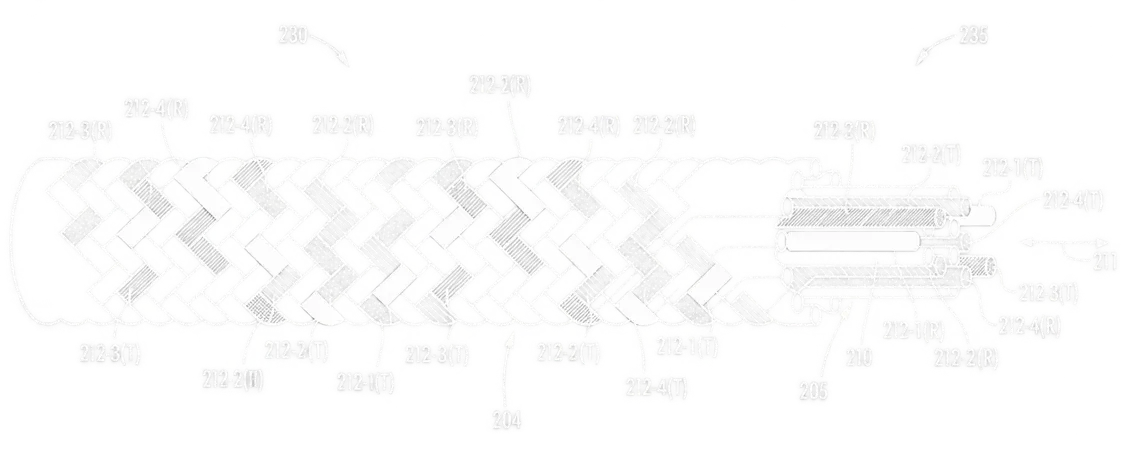
Patent-style drawing of a braided textile structure in which interlaced yarns form a flexible tube, with the end cut away to show the separate conductors running inside. Reference numerals label each yarn and conductor. Braiding conductive and insulating yarns together is one way to make a flexible, textile-based cable.
How the e-textile patent search works
The search is a single SQL query run against Google Patents Public Data on BigQuery. It looks for patent families whose earliest priority date is on or after 1 January 2013, and the archived data was extracted on 26 April 2026.
The query first removes “false friend” filings from unrelated fields, such as switching fabric, mesh networks, optical fibre and reinforced concrete. Anything left is kept if it meets one of four tiers.
- A curated set of patent classes that are densely populated with e-textile filings
- Broader textile-related classes, kept only when the title or abstract also uses e-textile language and the filing does not sit in an unrelated field such as cables, tyres or surgical instruments
- Battery and lighting classes, kept only alongside a definitive soft-goods word
- Unambiguous e-textile language such as “e-textile” or “electronic fabric”, whatever the classification, to catch filings placed in unexpected classes
Each patent family is then collapsed to one representative document, chosen by a weighted relevance score, so no invention is counted twice. As an initial check, a random sample of 200 families was reviewed by the authors and found to be overwhelmingly relevant, which we treat as an indicative rather than definitive evaluation.
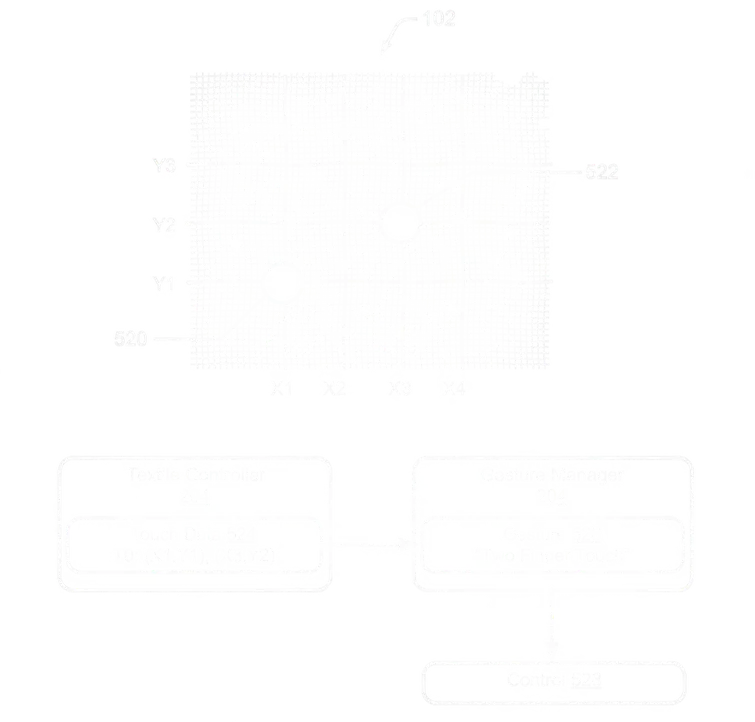
Patent-style drawing of a touch sensitive textile grid with two touches marked at grid positions, and below it a flowchart. A textile controller reports the touch data, a gesture manager recognises a two finger touch, and a control action follows. It shows how a fabric surface can act as an input device.
What is in the dataset
The dataset has one row per patent family, ready for landscape analysis in a spreadsheet or analysis tool.
- Publication, application and family numbers, with priority, filing, publication and grant dates
- Title, abstract and claims, preferring English, with claims of up to 32,000 characters
- Harmonised assignees, assignee countries, inventors and team size
- Patent classification codes and the relevance score
- Family-level statistics, including grant status, the jurisdictions filed in, and how many other families cite it
Google Patents Public Data is updated continuously, so rerunning the query later will not give an identical result. The archived dataset is the citable snapshot. Running the query yourself needs a Google Cloud project with billing enabled, as BigQuery charges for processing a dataset this size.
Who it is for, and its limits
The method is designed for academic researchers without formal patent training and for commercialisation-focused SMEs and spin-outs. It gives researchers a structured view of the patent record before they speak to an attorney, so that attorney time can go on legal analysis rather than preliminary searching. Legally consequential work such as freedom-to-operate opinions remains a job for professional searchers.
It is a deliberately transparent, best-effort search. The class choices, keyword patterns and include and exclude rules all involve judgement calls, so it will miss some relevant filings and admit some false positives. It is shared openly for reuse and scrutiny, and refinements are welcome.

A later stage of a woven textile with weft and warp with a channel incorporated for an electronic item. The woven nature of the base layer provides additional strength, and a fabric edge for the textile to be sewn or bonded to a garment, while providing high flexibility. Used for transmitting high power or shielded data across a garment, textile or outdoor application.
Next steps
Download the query and dataset, and please cite them if you use or adapt them. We presented our findings at the international E-Textiles conference in Pilsen. If you need help with patent landscaping, prior art or IP strategy for an e-textile or wearable product, see our Invention and IP and technical due diligence work, or get in touch.
Get the query and dataset for yourself
E-textile patent landscape, retrieval query and dataset
Bird, S., Lynch, M.J.
DOI: 10.5258/SOTON/D4013