Smart insole for diabetic foot care, designed for real clinics and long term wear
Our IEEE paper shows how an ultra-thin, battery-free smart insole was built with NHS clinicians to fit standard orthotic manufacturing at only £18 a pair.
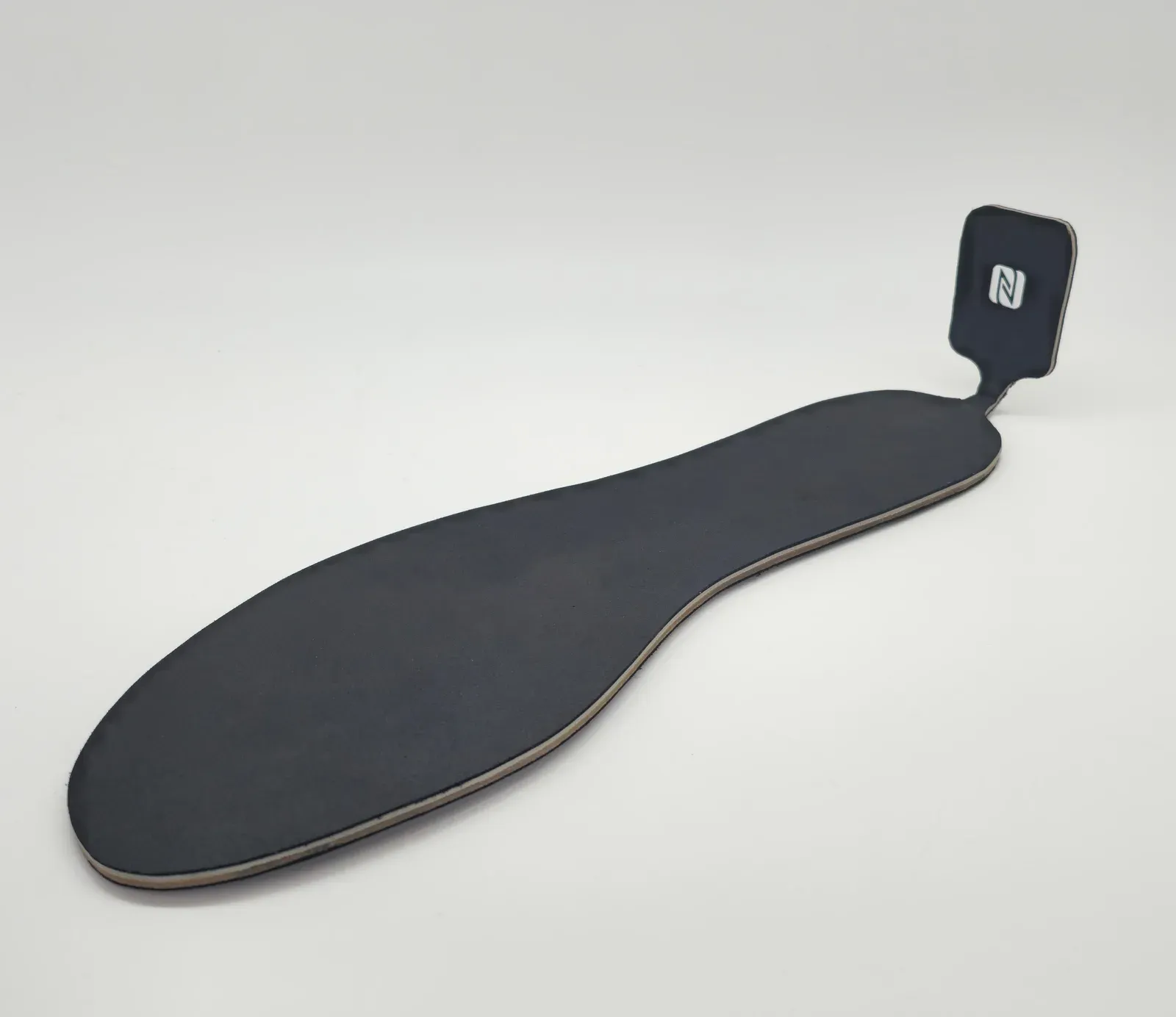
Smart insoles could transform diabetic foot care, but most designs so far have been too bulky, too costly or too much effort to use every day. Our new IEEE conference paper describes a smart insole built the other way round. It was designed with NHS clinicians to be made in an ordinary orthotic workshop, worn without a second thought and read in seconds with a clinician’s smartphone.
Why people with diabetes need a better smart insole
Diabetes can damage the nerves in the feet, a condition called peripheral neuropathy. People affected may not feel pressure building up, so steady pressure over a bony part of the foot can quietly turn into an ulcer. Diabetic foot ulcers are estimated to cost the NHS in England between £837 million and £962 million a year.
The standard treatment is an offloading insole that spreads pressure away from at-risk areas. It only helps while it is worn and while it is in good condition, and a worn-out insole can contribute to skin breakdown. A smart insole that tracks pressure and wear would let clinicians step in earlier and replace insoles at the right time.
So far, most smart insoles have been thick, heavy and expensive, with prices in the region of £1,500 to £2,500. Many face the burden of IoT devices, requiring charging, setting up and regular data uploads, which means taking them out of the shoe. For patients who already find it hard to keep up with treatment, that extra effort makes things worse.
Designed with clinicians, for real orthotic clinics
The project was clinician-centred from the start. Orthotists and clinical advisers gave feedback throughout. Their input set the brief around four everyday problems in the orthotic clinic.
- The insole had to be thin enough to sit in an ordinary shoe without changing its fit or creating new pressure points.
- It had to be light, because extra weight in footwear adds to the energy needed to walk.
- It had to be affordable next to the soft insoles, at around £25 a pair, and custom moulded insoles, at around £120 a pair, used in the NHS.
- It had to stay in the shoe, with nothing for the patient to charge, set up or upload.
It also had to fit how insoles are already made. Orthotic technicians hand-make custom insoles from standard materials, so the smart insole uses those same materials and fabrication methods. It needs no extra equipment and only minimal staff training.
How the smart insole works without a battery
The smart insole at a glance.
- Ultra-thin, and described in the paper as the thinnest in its class
- No battery and no microcontroller
- Powered and read wirelessly over NFC by a standard smartphone
- Senses compression in three directions, plus temperature to spot hot spots
- Made from standard orthotic materials, with a leatherboard base, a 1.5 mm Poron 4000 cushioning layer and 1 mm EVA covers
- Around £18 per pair
- Fits existing orthotic manufacturing with no extra equipment


Isometric line drawing of a batteryless smart insole with advanced multi-axis digital sensing. A flexible insole carries a recessed pocket under the arch and heel, and a narrow neck leads to a flat tab that holds the near-field communication (NFC) antenna and electronics. The insole is powered wirelessly by NFC energy harvesting, so it needs no battery, and suits gait analysis, plantar pressure and force sensing, diabetic foot monitoring and e-textile footwear research.
When a clinician holds a phone near the insole, the phone’s NFC signal powers the electronics for long enough to read the sensors and send the data back. The companion app shows the readings as graphs and a simple heatmap of the foot. The compression sensing sits in the cushioning layer, so the same readings can also show how the insole is wearing down over time.
Leaving out the battery and microcontroller takes away much more than weight. There is nothing to charge, no connectors to fail or let water in, no battery to swell and no firmware to load during production. Fewer parts also mean lower cost and a quicker build, which matters once you want to make insoles in volume.
Software built from scratch to make the insole useful
A smart insole is only as useful as the information a clinician can get out of it. With no battery, no microcontroller and no firmware, the insole relies entirely on the phone that reads it. So alongside the hardware, WearNex also developed a companion smartphone app from the ground up to power the insole, collect its data and turn it into something a clinician can understand at a glance.
The app runs on a standard smartphone, so clinics need no special readers or extra equipment. When the phone is held near the insole, the application powers the electronics over NFC, reads every sensor and gathers the values into a single view. It also shows the NFC connection status, so the clinician knows straight away that a reading has worked.
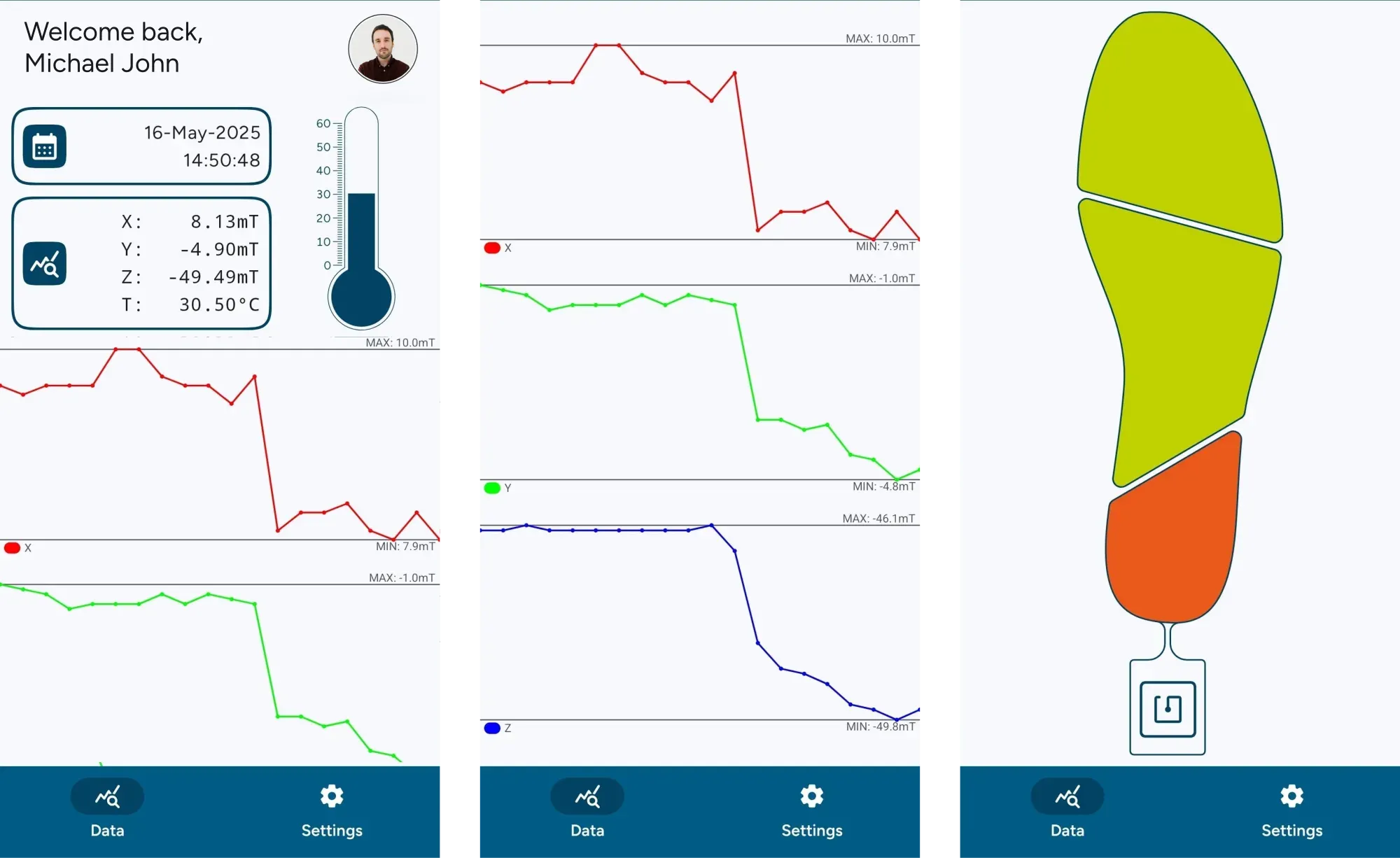
The data is then presented in two ways. Time traces show how compression changes in each of the three directions, which helps reveal how pressure builds and how the cushioning layer wears over time. A heatmap of the foot shows where pressure is concentrated, so at-risk areas stand out without the clinician needing to read raw numbers. The app also shows temperature, which helps spot hot spots that could signal a problem.
Building the software alongside the insole meant the whole system could be designed around how clinicians actually work. The result is a single tap-and-read step that fits into an ordinary appointment, with clear visuals that support quicker, better-informed decisions about when to adjust or replace an insole.
From lab prototype to clinical trial
A smart insole is only useful if it works on real feet, in real shoes, day after day. The insole is now the subject of a double blinded randomised controlled trial registered as ISRCTN51549193, which looks at whether smart insoles are as comfortable as standard practice. Data collection has finished and the results will follow in a future publication.
Trials like this are a big step for any e-textile. Every participant needs insoles that are made and behave consistently, so they have to come from a repeatable manufacturing process. Each one then has to cope with everyday wear, well away from the lab. A multi-user trial shows a fully integrated e-textile being made and used at scale within a standard treatment pathway, a step many promising lab prototypes never reach.
WearNex led the design for manufacture, flexible electronics integration, pilot builds and NFC app development, working alongside the University of Southampton and our clinical collaborators. The same approach runs through our e-textile product development, wearable product development and prototype to manufacture work.
Next steps
The full paper sets out the design, materials and system architecture in detail, and you can read it on IEEE Xplore. If you are developing a product that needs wireless or battery-free NFC sensing, flexible electronics built into textiles, or a clinical or multi-user trial with manufactured devices, get in touch to talk about your project.
Read the full paper
Overcoming Manufacturing Challenges in Smart Insole Development: Practical Pathways for Scaling in Diabetic Care
Lynch, M.J. et al.
2025 7th International Conference on the Challenges, Opportunities, Innovations and Applications in Electronic Textiles (E-Textiles), Roubaix, France, 2025, pp. 1-6